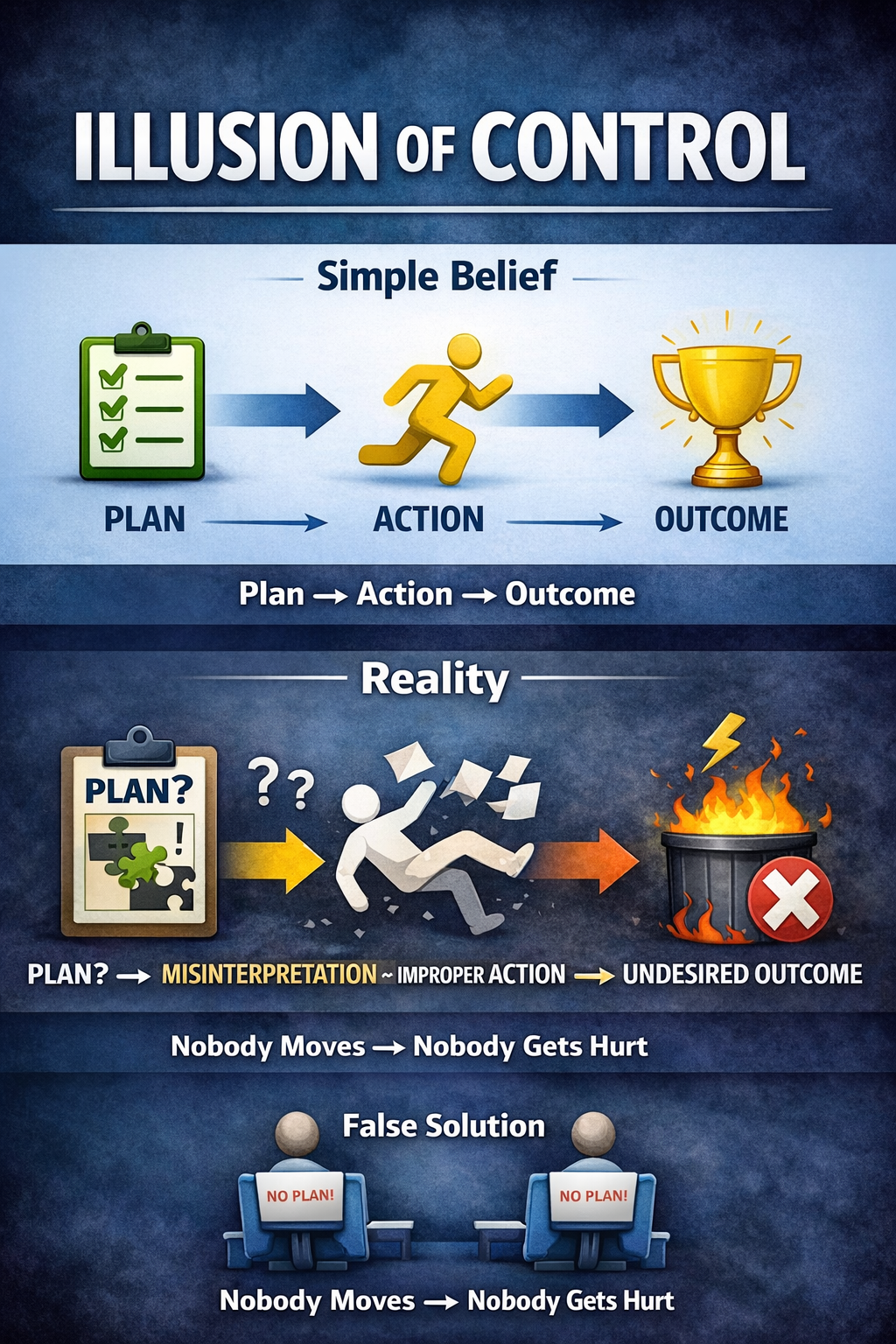
Fire prevention isn’t a downstream safety activity. It’s a planning decision. Organizations often treat fire risk as something handled by sprinklers, inspections, and emergency response. In reality, fire risk is largely created upstream, by how materials are ordered, staged, stored, and allowed to accumulate inside a facility
Production, supply chain, and safety are part of the same system. When they’re misaligned, fire risk quietly grows.

Fire risk begins with planning, not protection systems
Every pallet brought indoors increases three things at once:
- Fuel load
- Potential fire severity
- Business interruption exposure
If planning does not explicitly define how much material is allowed inside a space, accumulation becomes the default. Over time, temporary staging turns into permanent storage, often without anyone realizing the risk profile has changed.
The most effective fire-prevention control is answering one simple question early:
- How much material do we actually need inside the building right now to keep production moving?
Storage is a production constraint — not free space
Indoor storage feels inexpensive because the building already exists. That’s a false economy. Each square foot of stored material increases
- Heat release potential
- Smoke and water damage footprint
- Suppression system demand
- Cleanup and recovery time after an incident
Storage decisions directly affect loss magnitude. Designing storage based on convenience instead of hazard and flow leads to higher-risk fire scenarios—even in “compliant” buildings.
If material is not required for near-term production, it is acting as risk inventory, not productive inventory
Just-in-Time is also a fire-prevention strategy
Just-in-Time (JIT) is typically framed as a cost and efficiency model. It is also one of the most effective tools for reducing fire risk when applied intentionally. From a fire-prevention perspective, JIT:
- Limits combustible and hazardous inventory
- Reduces peak fuel loads
- Minimizes dust, residue, and spill accumulation
- Shrinks the size of credible fire scenarios
But JIT only works when lead times are understood and trusted.
Lead times are a safety variable
When lead times are unclear or unreliable, organizations compensate by over-ordering. That’s how accumulation happens—quietly and rationally. Strong systems treat lead time as both:
- A production input
- A fire-risk control
Practically, this means:
- Defining maximum intended inventory by area
- Linking reorder points to actual consumption
- Separating buffer stock from production space
- Using off-site or external storage where buffering is unavoidable
Predictable material flow is safer material flow.
Preventing accumulation without hurting production
There is no trade-off between safety and throughput when the system is designed well. High-performing operations consistently apply three principles:
- Stage for the shift, not the month, material at point-of-use matches the production window.
- Design for cleanability and visibility, smooth surfaces, sealed joints, and accessible areas prevent hidden buildup.
- Remove waste at the end of each cycle, scrap, residues, and empty containers are cleared before idle periods begin.
These practices reduce ignition potential while improving operational stability.